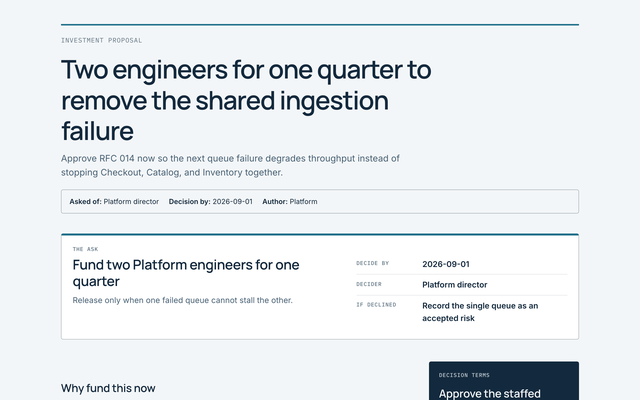
 Board voice
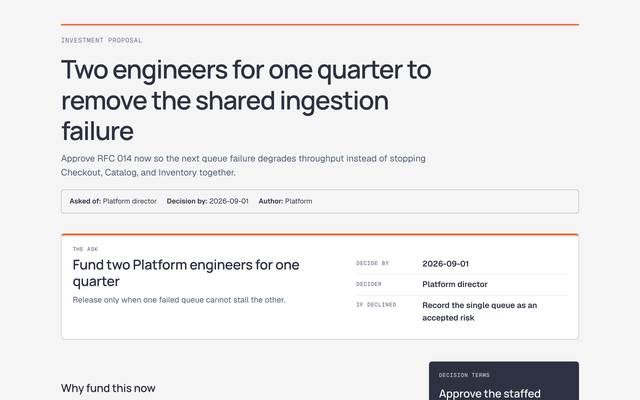 Analytical voice
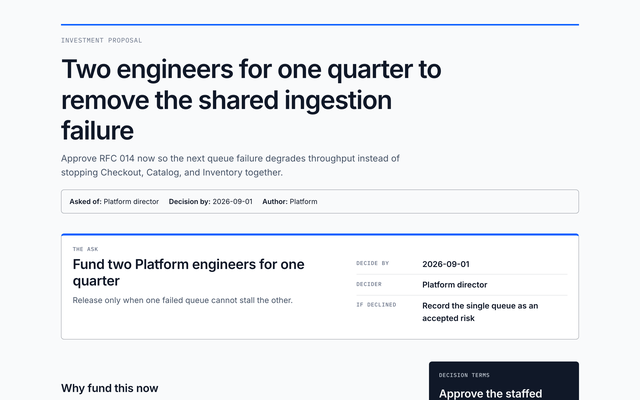 Client brand
One engagement, four acts
Northwind Ingestion runs every producer through one shared queue, and that queue keeps stopping all of them at once. RFC 014 splits it in two. Each act is a job readers are doing; each document is the shape their question needed.
Act 1: Understand. Something broke. What is actually true?
Before anyone proposes a fix, three readers need the facts in the shape of their own question.
-
For Platform and Reliability
What happened, why, and what stops it recurring?
Incident pattern. Impact comes before narrative, then a timeline, the cause, and corrective actions with owners.
-
For the platform review
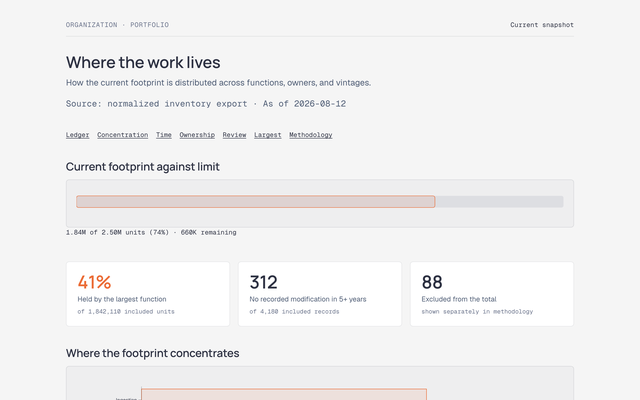
Where does the platform footprint sit, measured?
Analytical report. A measured claim carries its denominator: 41% of the footprint is 1.84M of 2.50M units.
-
For Platform, before funding the build
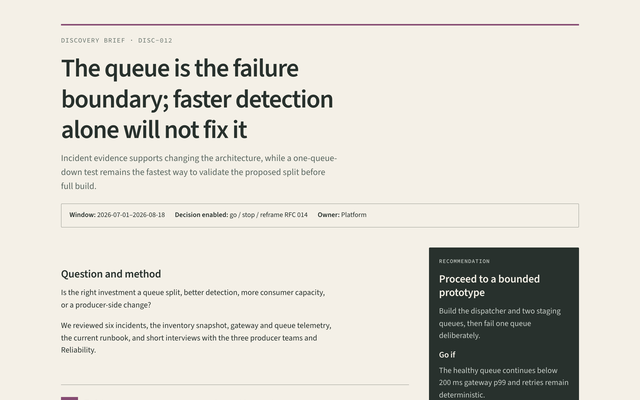
What did we learn, and should we proceed?
Decision pattern. It ends on a next move: go, stop or reframe RFC 014, with the one-queue-down test that decides.
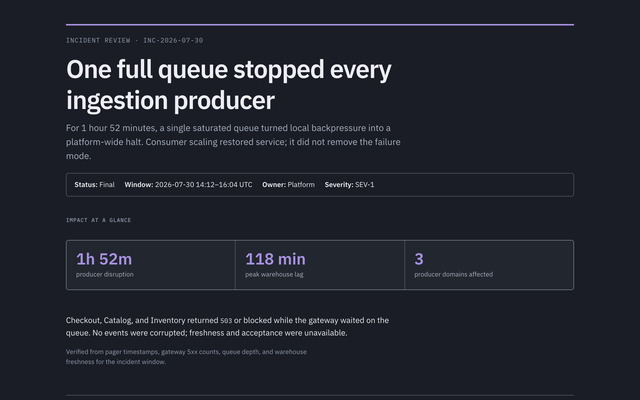
Act 2: Decide. Should we do this, and what will it take?
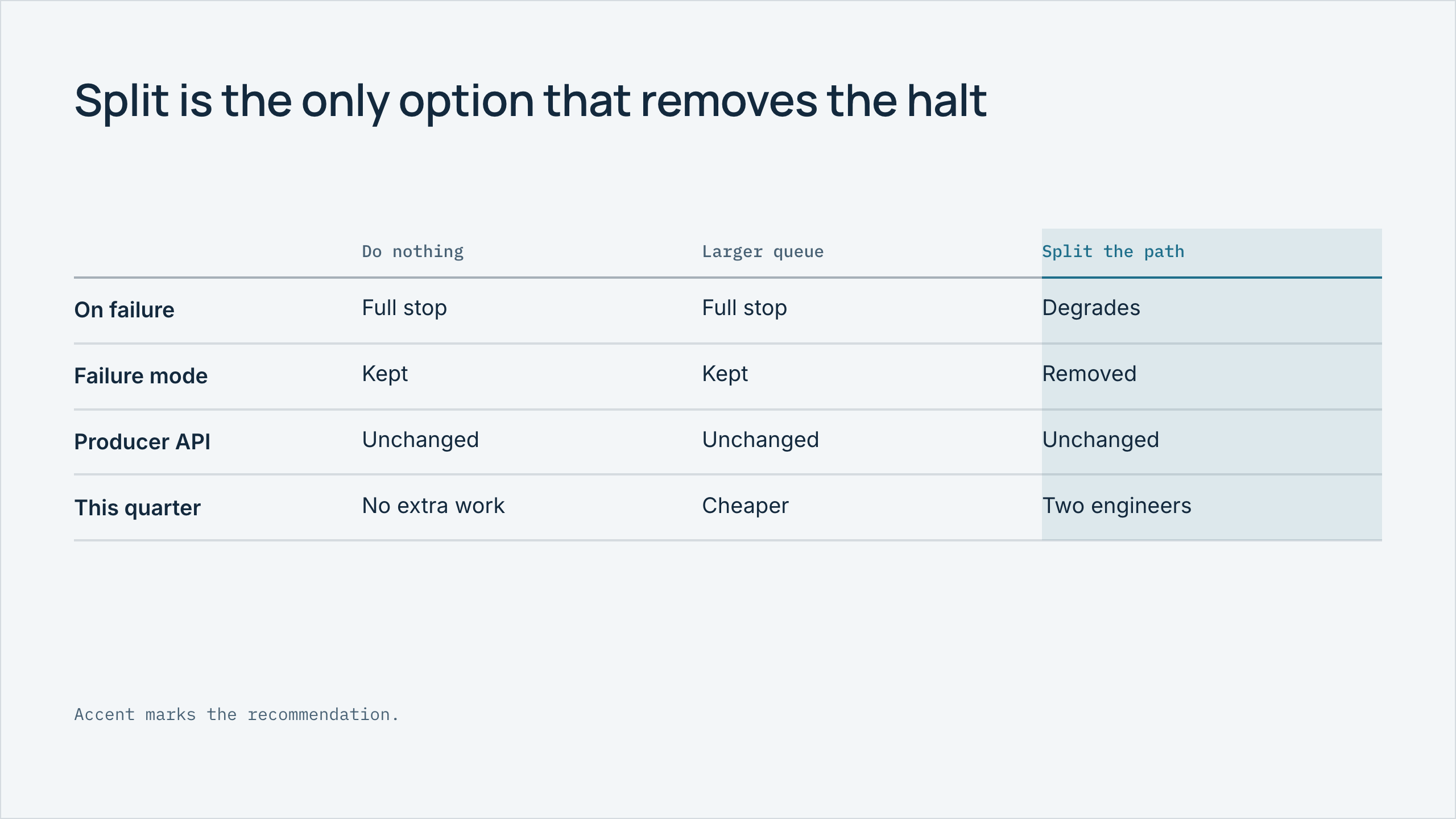
One decision, due 2026-09-01, reaches the Platform director three ways: argued, sized and presented.
-
For the Platform director, with Reliability and the producer teams reviewing
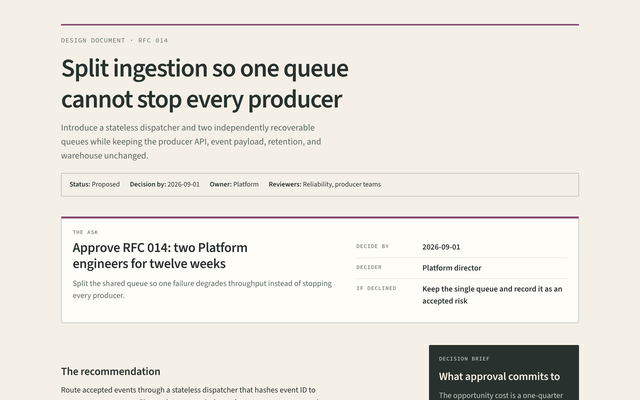
Should we do this, and is the approach sound?
Decision pattern. The ask and its deadline come first, then options on the same criteria and a change view of one queue becoming two.
-
For the Platform director
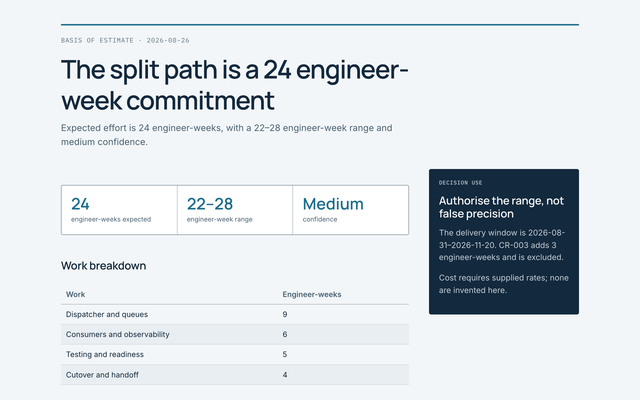
What will this take, and how confident are we?
Decision pattern. The number and its confidence lead; a waterfall adds up to 24 engineer-weeks and draws CR-003 without counting it.
-
For the Platform director, in the room
What are you asking me for, and by when?
Deck. The same decision in another medium: one claim per slide, and the options compared on the same criteria.
Act 3: Deliver. How do we get there without breaking producers?
With the work under way, the questions turn to sequence, current state and proof.
-
For Platform, Reliability and the producer teams
How will the agreed outcome be delivered and governed?
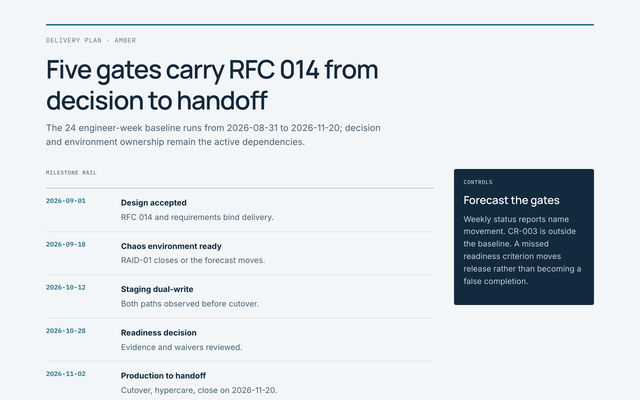
Plan pattern. Baseline, workstreams, dependencies, then five gates; the critical path is the one accent in the dependency graph.
-
For the Platform director, Platform and Reliability
Where are we now, and what needs attention?
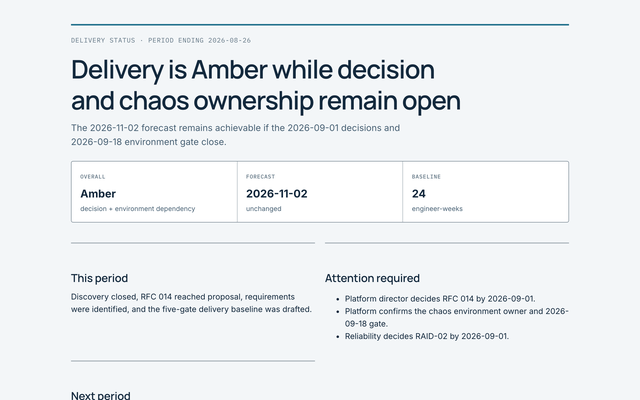
Brief pattern. Amber first, then what moved, then the one action each reader owns before the next report.
-
For Reliability, which approves the gate
Is this change ready for production?
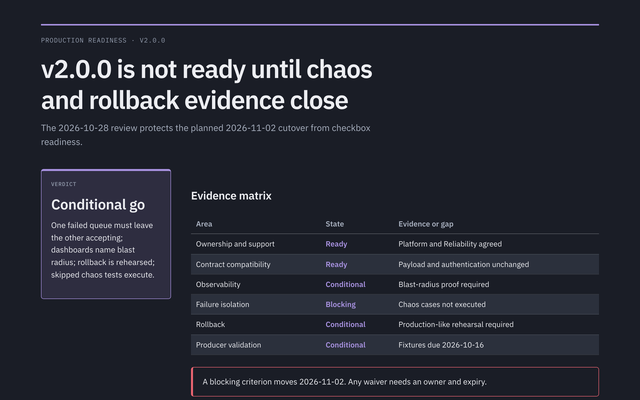
Assurance pattern. The verdict comes first with its evidence beside it: conditional go until chaos and rollback evidence close.
-
For Platform, running the cutover
How do we move safely and back out?
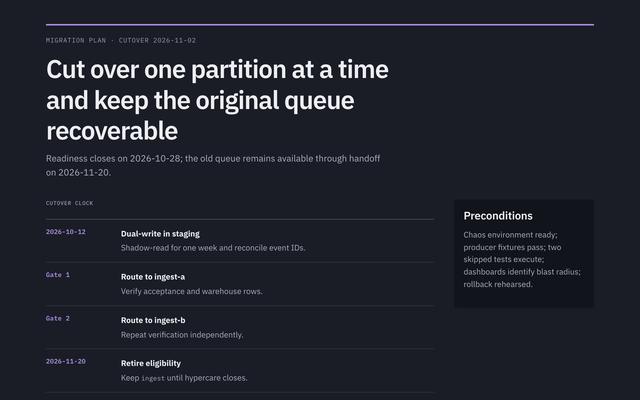
Plan pattern. Rehearsal, sequence and gates, one partition at a time, with the original queue kept until hypercare closes.
Act 4: Run and hand on. Who keeps it alive, and how does the next engineer learn it?
The last readers are the ones who stay, and the last question is one no preset answers.
-
For on-call, while the lag alert is firing
What do I do right now?
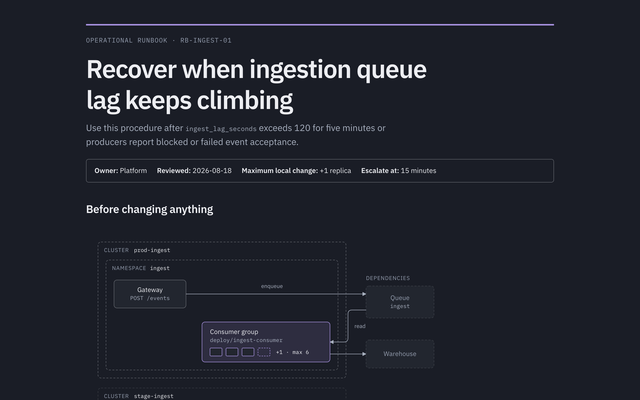
Procedure pattern. Safety before steps, a checkpoint after each, and a deployment map of cluster, namespace and replicas.
-
For an engineer joining from batch and warehouse work
Can I reuse what I know from batch loads here?
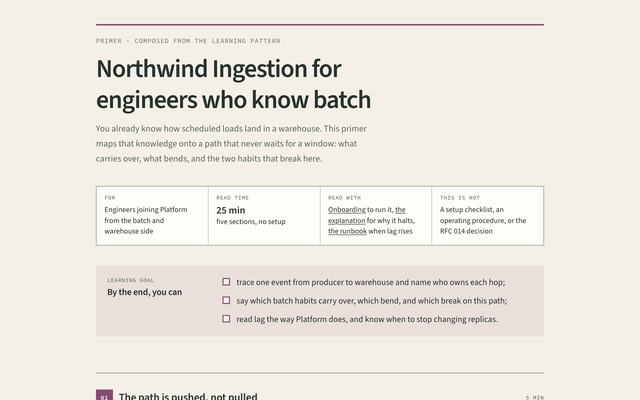
Learning pattern, composed. No preset answers it. The question picks the learning pattern, and the page is composed from that pattern's modules: a scope strip, a learning goal, a crosswalk and takeaways.
Twelve documents, seven patterns, four voices, one ledger of facts. A shape composed three times becomes a preset; that is the only way the catalog grows.