Skip to content

Mule-Lint

Mule-Lint Documentation

Welcome to the Mule-Lint documentation. This documentation is organized into two sections: MuleSoft Best Practices (for integration developers and AI agents) and Linter Technical Documentation (for mule-lint contributors).


📘 MuleSoft Best Practices

Comprehensive guidelines for building maintainable, secure, and performant Mule 4 applications. Each guide is a focused, self-contained reference that can be read independently.

Core Development

Document Description
Best Practices Index Master index with quick reference card and API-Led overview
API Contract Validation RAML/OpenAPI validation, local rulesets, and automation behavior
Error Handling Global error handlers, HTTP vs. event-driven patterns, connector error types, CRM error log objects
Variable Contracts Standard variables, correlation IDs, array mirroring, action routing
Logging Categories, structured JSON logging, MDC/tracing, PII prevention
Security Secure properties, TLS 1.2+, credentials, zero-trust architecture
Performance Timeouts, connection pooling, async error handling, streaming, bulk lookup (N+1 prevention)

Architecture & Patterns

Document Description
Event-Driven Patterns Platform Events, Anypoint MQ, VM Queue Dispatcher, scheduler watermarking, deferred task polling
Connector Patterns Entity config YAML, SF/NS connector gotchas, protocol negotiation, ObjectStore caching
DataWeave Patterns Modules, type coercion, cross-system value mapping (4 strategies), import path rules

Project & Operations

Document Description
Folder Structure Standard Maven layout for Mule 4 projects
Documentation Standards Flow documentation, README templates, commit messages
Testing (MUnit) Test structure, error scenario testing, event-driven testing
CI/CD Integration Pipeline stages, mule-lint integration, quality gates
Deployment & Modernization CloudHub 2.0, Java 17, Anypoint Code Builder, API Governance

Reference

Document Description
Rules Catalog Complete reference for all 82 lint rules with examples
Standards Catalog Canonical outcomes, classifications, and sources

⚙️ Using mule-lint

Document Description
Configuration .mulelintrc.json keys, precedence, per-rule options
Rule profiles Stable rule sets and compatibility contract
Output formats Table, JSON, SARIF, HTML, CSV, and what each exit code means
Quality gates Built-in and custom gates, plus the A–E rating formulas

🔧 Linter Technical Documentation

For contributors and those extending mule-lint.

Document Description
Architecture System design, patterns, and data flow
Rule Engine Rule engine internals and interfaces
Extending How to create custom rules
Folder Structure Linter project organization
Naming Conventions Code style and naming standards
MCP Design MCP server architecture and tool/resource design

Quick Start

Installation

npm install -g @sfdxy/mule-lint

Common Commands

# Scan with human-readable output
mule-lint ./src/main/mule

# Scan with JSON output
mule-lint ./src/main/mule -f json

# Scan with SARIF output for AI agents/IDEs
mule-lint ./src/main/mule -f sarif

# Generate HTML report
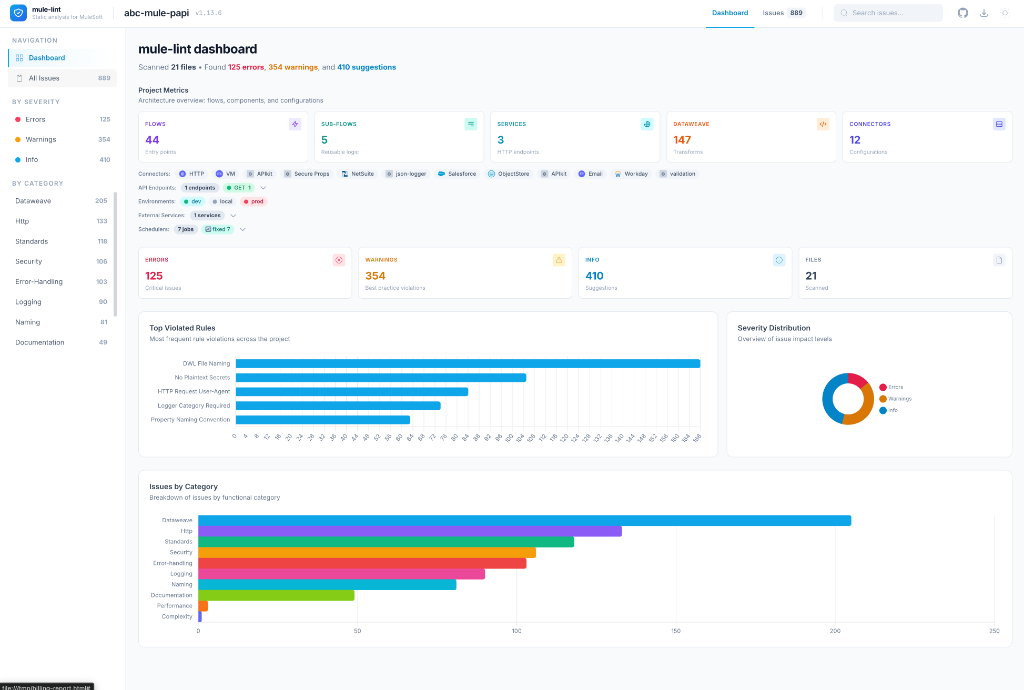
mule-lint ./src/main/mule -f html -o report.html

# Use config file
mule-lint ./src/main/mule -c .mulelintrc.json

# CI/CD: fail on warnings
mule-lint ./src/main/mule --fail-on-warning

Exit Codes

Code Meaning
0 Success (no errors)
1 Errors found
2 CLI/Configuration error
3 Parse errors (malformed XML)

Rule Families

Counts are per identifier prefix, taken from the rule registry.

Prefix Count Covers
MULE-XXX 29 Core Mule 4 XML validation
SEC-XXX 8 Secure properties, TLS, credentials, rate limiting
API-XXX 8 API-Led and APIKit patterns
DW-XXX 5 DataWeave file validation
HYG-XXX 5 Code hygiene, unused flows and variables
ERR-XXX 4 Error handler structure and coverage
YAML-XXX 3 YAML property configuration
OPS-XXX 3 Auto-discovery, ports, externalized schedules
EXP-XXX 3 Experimental rules for evaluation
LOG-XXX 2 Structured logging and sensitive data
RES-XXX 2 Reconnection and listener resilience
CFG-XXX 2 Configuration properties and environment parity
PROJ-XXX 2 POM and Git hygiene
SF-XXX 2 Salesforce and event connector rules
HTTP-XXX 1 HTTP connector configuration
PERF-XXX 1 Connection pooling
DOC-XXX 1 Display names and documentation
STD-XXX 1 Coding and API standards

Total: 82 rules across 18 prefixes and 16 runtime categories. A prefix groups identifiers; a category is the category field a rule reports, which is what configuration and quality gates filter on. The two do not map one to one.


For AI Agents

MCP Resources

All best practice guides are available via the MuleSoft Lint MCP server:

mule-lint://rules                          → JSON catalog of all 82 rules
mule-lint://rules/{id}                     → Structured metadata for one rule
mule-lint://standards                      → Canonical engineering standards
mule-lint://standards/{id}                 → One standard with classification and sources
mule-lint://docs/best-practices            → Master index and quick reference
mule-lint://docs/error-handling            → Error handling patterns
mule-lint://docs/event-driven              → Event-driven architecture
mule-lint://docs/connectors                → Connector configuration
mule-lint://docs/variables                 → Variable contracts
mule-lint://docs/dataweave                 → DataWeave patterns
mule-lint://docs/security                  → Security best practices
mule-lint://docs/logging                   → Logging standards
mule-lint://docs/performance               → Performance optimization
mule-lint://docs/testing                   → MUnit testing
mule-lint://docs/deployment                → Deployment & modernization
mule-lint://docs/ci-cd                     → CI/CD integration
mule-lint://docs/folder-structure          → Project structure
mule-lint://docs/documentation-standards   → Documentation standards
mule-lint://docs/rules-catalog             → Complete rules reference

SARIF Output

Use SARIF output for structured results:

mule-lint ./src/main/mule -f sarif > report.sarif

SARIF output follows the SARIF 2.1.0 specification with rule definitions, precise file locations, and fix suggestions.